
TAKE ACTION TODAY
Harm by Design.
The online world is harmful by design.
Join us in supporting the Canadian Government’s legislation (Bill C-34) to stop harm by design.
From a youth suicide prevention expert lens, our involvement in the issue of social media and youth mental health has been steadfast, informed by experts and those whose lived experiences of social media and AI contributed to the development of mental health challenges.
Since 2023, Myles Ahead has been coordinating collective action and lobbying the Canadian Government to introduce a youth-centred digital safety regulatory framework.
Our advocacy ensured the legislation proposed in 2023 (Bill C-63) mandated social media services to protect children from suicide and self-harm promotion and algorithms. We applaud the introduction of Bill C-34 the Safe Social Media Act.
As the Canadian government has just introduced Bill C-34 (Safe Social Media Act). Big Tech is lobbying hard against it, particularly minimum age requirements. There is no better time to make your voice heard than right now. Read below to learn why we support a youth-centred digital safety regulatory framework, including measures for minimum age requirements.
Legislation is the first step. We need to ensure liability is enforced across digital platforms and AI, and work to build greater awareness about harm by design.
Support youth-centred safety by design legislation in Canada enforcing liability for
social media
and AI
harm by design.

Social media and AI
minimum age requirements
and
privacy protections
for children and youth.
Include Youth & Caregivers with lived experience of online harms in the development of Canada’s regulatory framework and resources including:
- Peer-led digital safety and crisis recovery interventions
- Harm-by-design system literacy in communities and schools.
Cars, Drugs, Airplanes come with rules. AI does not. Remember what social media did to our kids? Teen girls’ depression is up 145% since 2010. Teen suicide rose in lockstep. The same five companies that built those platforms are now racing to deploy AI, a thousand times more powerful, with zero new rules.
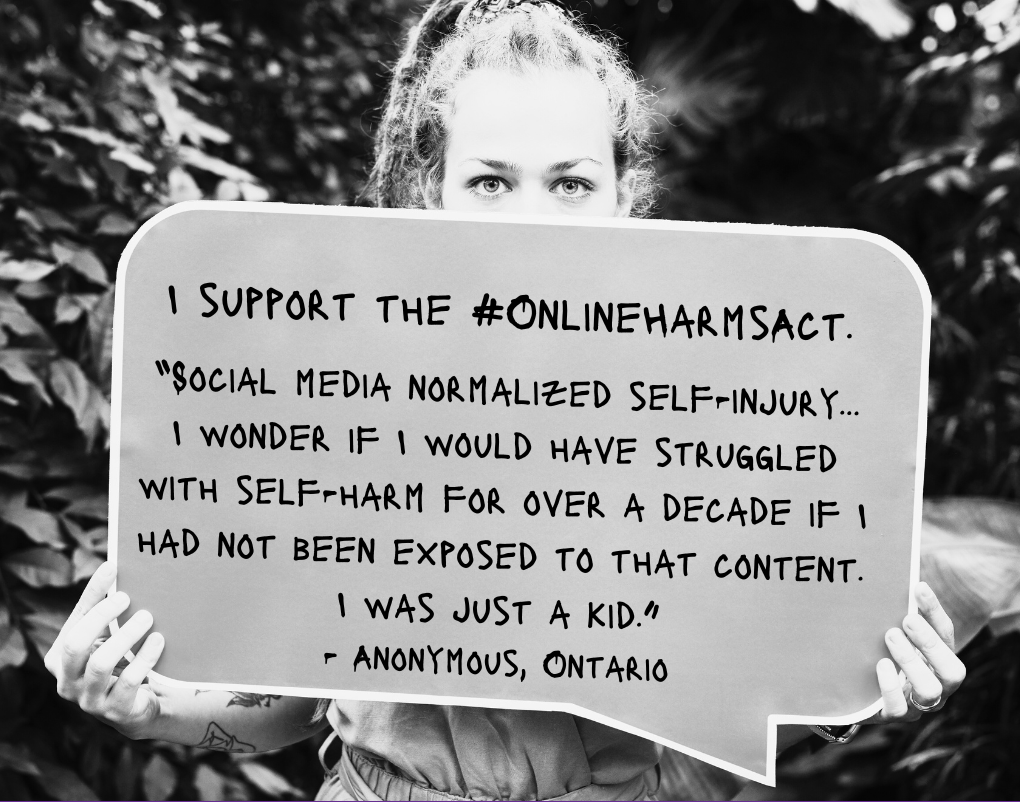
After receiving my first smartphone at thirteen, I spent nearly a decade navigating the quiet anxiety of identity confusion, self-harm, suicidality, and disconnection which ultimately resulted in employment struggles and debt in my early twenties – all caused by growing up online. What I experienced was not an isolated struggle, but part of a broader public health challenge affecting an entire generation.
Tumbler Ridge is another wake-up call that cannot be ignored:
a watershed moment exposing the negligence of Big Tech.
Putting profits and ‘tech innovation’ before kids must stop.
From Tumbler RIdge and Beyond, learn more about Harm by design
The following examples document online harm by design, and show why legislation is so important:
- Canadians were confronted not only with the tragedy of a school shooting at Tumbler Ridge itself that left six school children and two adults dead, but the unfolding revelations that OpenAI leadership ignored staff recommendations to pass information correctly identifying the shooter’s imminent risk on to Canadian law enforcement. With no statutory duty to escalate, their failure to act independently reflects a moral crisis in AI and the urgent need for regulation in Canada.
- Recent reports indicate that AI chatbots could even aid in violent attacks, with The Centre for Countering Digital Hate reporting that that AI chatbots can be used to plan violent attacks and self-harm.
- Child pornography is increasing with perpetrators freely streaming and sharing files. Tools that can readily detect and prevent such material are not being used.
- In a move to shut down free speech, Elon Musk is using his millions to sue those who voice issues about child safety. He has defended the proliferation of images and accounts on X, failing to remove images, forcing governments and individuals to pursue costly legal action, repeatedly.
- Platforms started by ‘incels’ and other “ideologically motivated violent extremists” encourage suicide and self-harm as a radical act, with links to methods and a ‘community’ of pressure and support for enacting suicidal plans. Linked to the deaths of at least 45 people, including minors, and a number of young Canadians, Google refuses to actand incorporate best practice standards in suicide prevention.
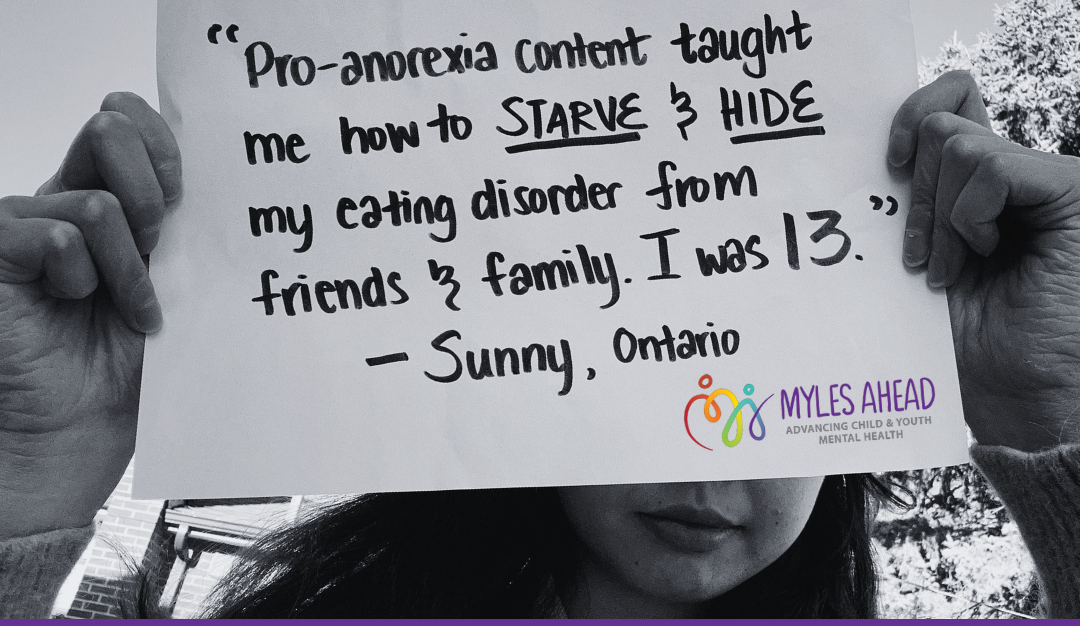
- Whistleblowers testified that Meta knowingly allowed algorithm systems to push anorexia-promoting material to youth and Zuckerberg ignored recommendations to protect kids.
- Fake TikTok accounts emulating children as young as 13 posting about diet and exercise were shown to be instantly, graphically, and relentlessly bombarded with disordered eating, self-harm, and suicide content.
- In Ontario, girls with eating disorders, distress, anxiety and self-harming behaviours continue to grow exponentially — a global trend facing our emergency rooms with mounting evidence of the association between social media use and increased depression, anxiety, self-harm, and disordered eating. In a recent article in the Toronto Star, we spoke about the young women who were hospitalized at SickKids hospital and had wished, with hindsight, that through their early teen years they had been better shielded from social media. They spoke about being relentlessly bombarded by self-harm and pro-anorexia content.
- Young men highlighted the impact of hyper-masculinity online, in particular the narratives emerging from the ‘manosphere’ and pressures to conform with trends such as ‘looksmaxxing‘.
- The World Happiness Report reveals for the first time young people are the unhappiest with 4/5 Gen Z young adults describing social media use as addictive and 23% of Canadian teens spending 35+ hours/ week on social media.
Read more about how harm by Design is impacting Canadians
The impacts are devestating, affecting families across Canada:
- After being targeted by a ‘sextortionist’ on Snapchat, 16-year-old Prince Edward Island boy took his life. Despite Meta having the technology to intervene, international extortion rings target boys aged 14-24 who are tricked into exchanging explicit images online and then blackmailed.
- Despite Meta and Snapchat having the means to intervene, international ‘sextortion’ rings continue to target boys aged 14-24. With no access to justice, dignity or privacy, vulnerable young people are left with hopelessness and despair. The high profile case of British Columbian teen Amanda Todd who died by suicide aged 15 after being relentlessly harassed and sextorted by a man in the Netherlands is the tip of the iceberg. After being targeted by a ‘sextortionist’ on Snapchat, a 16-year-old Prince Edward Island boy died by suicide.
- A woman sexually abused as a young girl is now fighting to have images of her abuse removed online, suffering post-traumatic stress and continued revictimization.
- PornHub continues to drag its heels in removing child sex abuse material on its platform. Meanwhile writing op-eds in the Globe and Mail to tell us that legislation will infringe on our privacy. Where is their concern for the privacy and dignity of children?
- The most recent X/Grok ‘nudification’ scandal alone shows how little children and women, in particular, are safeguarded in this space